

Recurring vs. One-Time NIL Income: How to Build Earnings That Actually Last
8 min read

There are two kinds of NIL income, and most athletes only think about one of them.
The one they think about is the brand deal. A company reaches out, an agreement gets signed, content goes live, and a payment comes through. It feels like a win because it is one. But when the campaign ends, the income ends with it. Then it's back to waiting for the next opportunity.
The kind they don't think about enough is recurring income. Money that comes in regularly, that doesn't depend on a new deal being signed every few weeks, and that keeps growing the more fans you bring into your community.
Understanding the difference between these two income types is one of the most practical things a college athlete can do for their NIL. This guide walks through both, explains how they work in real life, and shows how NIL Club helps athletes build a mix of both for earnings that are actually consistent.
The one they think about is the brand deal. A company reaches out, an agreement gets signed, content goes live, and a payment comes through. It feels like a win because it is one. But when the campaign ends, the income ends with it. Then it's back to waiting for the next opportunity.
The kind they don't think about enough is recurring income. Money that comes in regularly, that doesn't depend on a new deal being signed every few weeks, and that keeps growing the more fans you bring into your community.
Understanding the difference between these two income types is one of the most practical things a college athlete can do for their NIL. This guide walks through both, explains how they work in real life, and shows how NIL Club helps athletes build a mix of both for earnings that are actually consistent.
What One-Time NIL Income Looks Like
One-time income is exactly what it sounds like. You do something, you get paid for it, and then it's done.
Brand deals and sponsorships are the most common example. A company pays you to post about their product, appear in an ad, or show up at an event. You fulfill the terms of the agreement, they send payment, and the arrangement wraps up. Sometimes these deals lead to long-term partnerships, but most of the time they're a single transaction.
Personal appearances work the same way. You sign autographs at a local business, show up at a fan event, or record a personalized video for someone through a platform like Cameo. One-time income, done.
Group licensing deals, like having your likeness in a video game, also fall here. You opt in once, receive a payment, and the deal runs its course.
None of this is bad. One-time income can pay very well. A single strong brand deal can earn more in a week than some athletes see in a semester. The issue isn't that one-time income isn't valuable. The issue is that it's unpredictable. Some months you have three deals lined up. Other months there's nothing. And when you're trying to manage a real schedule of practices, classes, travel, and recovery, chasing down new deals constantly is genuinely hard.
Brand deals and sponsorships are the most common example. A company pays you to post about their product, appear in an ad, or show up at an event. You fulfill the terms of the agreement, they send payment, and the arrangement wraps up. Sometimes these deals lead to long-term partnerships, but most of the time they're a single transaction.
Personal appearances work the same way. You sign autographs at a local business, show up at a fan event, or record a personalized video for someone through a platform like Cameo. One-time income, done.
Group licensing deals, like having your likeness in a video game, also fall here. You opt in once, receive a payment, and the deal runs its course.
None of this is bad. One-time income can pay very well. A single strong brand deal can earn more in a week than some athletes see in a semester. The issue isn't that one-time income isn't valuable. The issue is that it's unpredictable. Some months you have three deals lined up. Other months there's nothing. And when you're trying to manage a real schedule of practices, classes, travel, and recovery, chasing down new deals constantly is genuinely hard.
What Recurring NIL Income Looks Like
Recurring income is money that comes in on a regular cycle without you having to restart the process every time.
The clearest example in NIL is fan subscriptions. When a fan subscribes to your NIL Club page, they pay a monthly fee in exchange for exclusive content from you and your teammates. That payment renews automatically each month as long as they stay subscribed. You don't have to renegotiate anything. You don't have to find a new brand willing to work with you. You just keep showing up, sharing content your fans actually want to see, and the income keeps coming.
There's something genuinely different about how recurring income feels to manage. When you know a certain amount is coming in each month, you can plan around it. You can focus on your sport without that background noise of wondering where the next deal is coming from. It changes the relationship you have with NIL from something reactive to something stable.
For athletes in non-revenue sports especially, this matters a lot. Revenue sharing from the school is often minimal or nonexistent for these athletes, and national brand deals don't always come knocking for swimmers, wrestlers, or cross country runners the way they do for quarterbacks. Fan subscriptions through NIL Club level that playing field in a real way.
The clearest example in NIL is fan subscriptions. When a fan subscribes to your NIL Club page, they pay a monthly fee in exchange for exclusive content from you and your teammates. That payment renews automatically each month as long as they stay subscribed. You don't have to renegotiate anything. You don't have to find a new brand willing to work with you. You just keep showing up, sharing content your fans actually want to see, and the income keeps coming.
There's something genuinely different about how recurring income feels to manage. When you know a certain amount is coming in each month, you can plan around it. You can focus on your sport without that background noise of wondering where the next deal is coming from. It changes the relationship you have with NIL from something reactive to something stable.
For athletes in non-revenue sports especially, this matters a lot. Revenue sharing from the school is often minimal or nonexistent for these athletes, and national brand deals don't always come knocking for swimmers, wrestlers, or cross country runners the way they do for quarterbacks. Fan subscriptions through NIL Club level that playing field in a real way.
Why Most Athletes Lean Too Hard on One-Time Income
It makes sense that athletes default to chasing brand deals. They're visible. They're exciting. And the sports media tends to cover the big ones, which makes them feel like the standard.
But the athletes who rely almost entirely on one-time income end up on a treadmill. A deal comes in, they complete the work, the money arrives, and then the cycle has to start all over. There's no foundation underneath it. If a busy stretch of the season makes it harder to take on new commitments, or if a quiet period means fewer brands are reaching out, income drops fast.
The other thing that happens is that one-time deals can create pressure to say yes to things that aren't actually a good fit. When you need income and don't have a reliable base, you start taking deals because you need the money rather than because they make sense for your brand. That's a quick way to undermine the audience trust you've been working to build.
A stable recurring income base changes all of that. It gives you the flexibility to be more selective about the brand deals you take, which usually means better deals over time.
But the athletes who rely almost entirely on one-time income end up on a treadmill. A deal comes in, they complete the work, the money arrives, and then the cycle has to start all over. There's no foundation underneath it. If a busy stretch of the season makes it harder to take on new commitments, or if a quiet period means fewer brands are reaching out, income drops fast.
The other thing that happens is that one-time deals can create pressure to say yes to things that aren't actually a good fit. When you need income and don't have a reliable base, you start taking deals because you need the money rather than because they make sense for your brand. That's a quick way to undermine the audience trust you've been working to build.
A stable recurring income base changes all of that. It gives you the flexibility to be more selective about the brand deals you take, which usually means better deals over time.
How the Two Work Together
The athletes who have figured this out aren't choosing between recurring and one-time income. They're using both, and they think of them as doing different jobs.
Recurring income is the foundation. It's predictable, it grows gradually, and it keeps things stable during stretches when brand deals are slow. One-time income is the opportunity layer. It adds to the foundation, often significantly, and it can grow substantially as your audience and reputation build.
Think of it like this. If you have a few hundred dollars coming in each month from fan subscriptions on NIL Club, you're not scrambling every time a brand deal falls through or gets pushed back. You have breathing room. And that breathing room makes you a better partner for brands, because you're not coming to the table out of desperation.
Over time, as your subscriber base grows, the recurring income base grows with it. Meanwhile, a stronger fan community and higher engagement on your NIL Club page also makes you more attractive to brands, which improves the one-time income side too. The two streams reinforce each other.
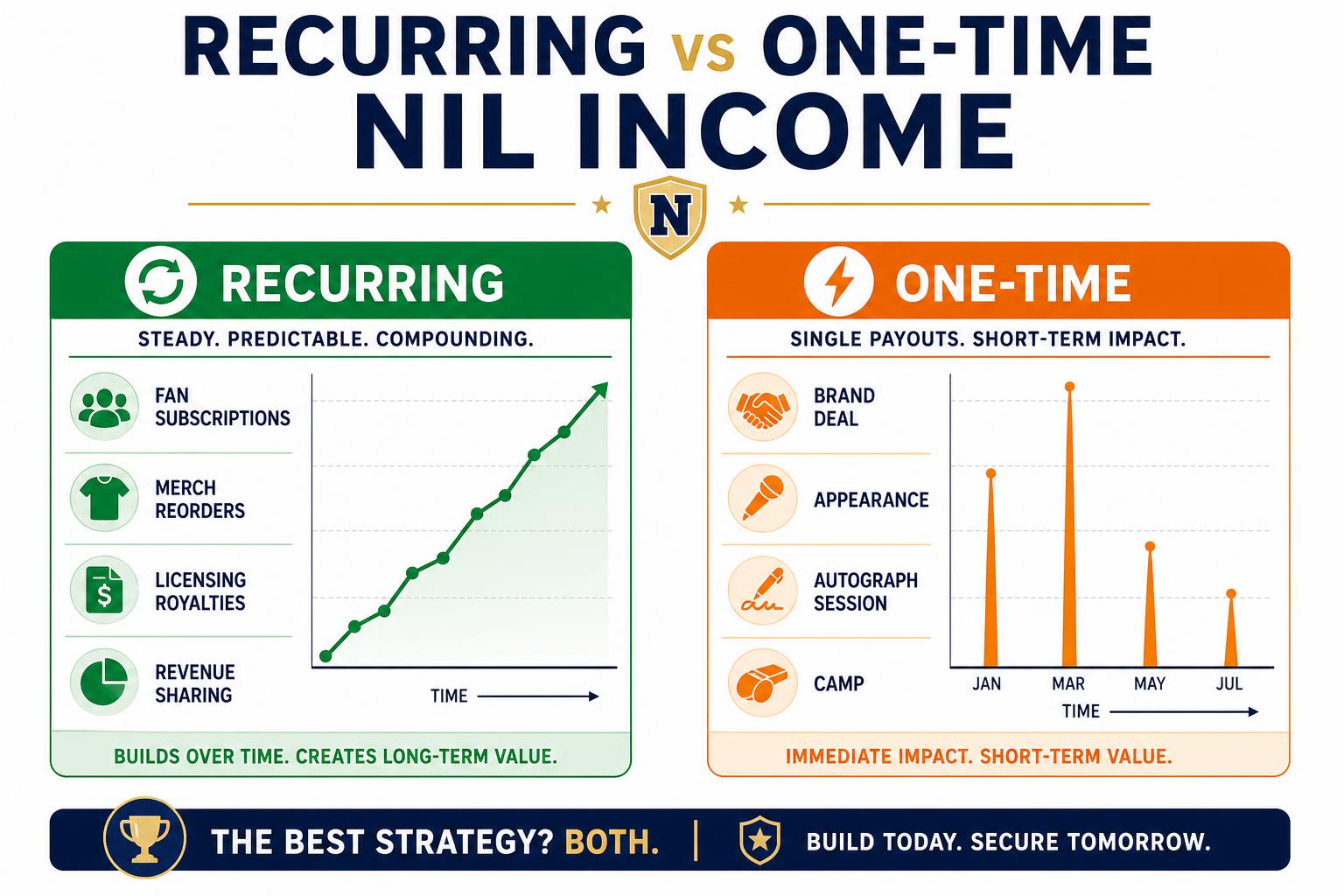
Recurring income is the foundation. It's predictable, it grows gradually, and it keeps things stable during stretches when brand deals are slow. One-time income is the opportunity layer. It adds to the foundation, often significantly, and it can grow substantially as your audience and reputation build.
Think of it like this. If you have a few hundred dollars coming in each month from fan subscriptions on NIL Club, you're not scrambling every time a brand deal falls through or gets pushed back. You have breathing room. And that breathing room makes you a better partner for brands, because you're not coming to the table out of desperation.
Over time, as your subscriber base grows, the recurring income base grows with it. Meanwhile, a stronger fan community and higher engagement on your NIL Club page also makes you more attractive to brands, which improves the one-time income side too. The two streams reinforce each other.
How NIL Club Supports Both
NIL Club was built to help athletes earn from both sides of this, and that was an intentional choice.
The subscription model is at the core of what we do. Athletes set up a team community page, and fans subscribe monthly to get exclusive content directly from the athletes they follow. Every athlete on the team earns an equal share of that revenue. There are no boosters making allocation decisions, no university administrators in the approval chain, and no third parties skimming from the top. The platform is 100% student-run, which means athletes manage the experience themselves and keep the focus on what actually works for their schedule and their community.
We're the largest team-based NIL platform in college sports, with more than 650,000 student-athletes across 2,000-plus schools and 20,000-plus team communities. That reach gives the subscription side of things real momentum. Fans who care about college sports across dozens of programs are already in the ecosystem, and athletes can tap into that existing community from the moment they get started.
On the one-time income side, NIL Club's brand deals feature connects athletes directly with companies that want to run campaigns at scale. This matters a lot for athletes who don't have the individual follower count to attract national brands on their own. When a brand runs a team campaign through NIL Club, athletes who are part of that team community can participate in deals they'd never access independently. It opens the door to one-time income that wouldn't otherwise exist.
The combination of steady subscription income and access to brand deals is what makes the NIL Club model different from platforms that only focus on one side of the equation.
The subscription model is at the core of what we do. Athletes set up a team community page, and fans subscribe monthly to get exclusive content directly from the athletes they follow. Every athlete on the team earns an equal share of that revenue. There are no boosters making allocation decisions, no university administrators in the approval chain, and no third parties skimming from the top. The platform is 100% student-run, which means athletes manage the experience themselves and keep the focus on what actually works for their schedule and their community.
We're the largest team-based NIL platform in college sports, with more than 650,000 student-athletes across 2,000-plus schools and 20,000-plus team communities. That reach gives the subscription side of things real momentum. Fans who care about college sports across dozens of programs are already in the ecosystem, and athletes can tap into that existing community from the moment they get started.
On the one-time income side, NIL Club's brand deals feature connects athletes directly with companies that want to run campaigns at scale. This matters a lot for athletes who don't have the individual follower count to attract national brands on their own. When a brand runs a team campaign through NIL Club, athletes who are part of that team community can participate in deals they'd never access independently. It opens the door to one-time income that wouldn't otherwise exist.
The combination of steady subscription income and access to brand deals is what makes the NIL Club model different from platforms that only focus on one side of the equation.
Building an Income Mix That Works for You
Getting the balance right doesn't require a complicated strategy. It mostly comes down to starting with the thing you can control and building from there.
The subscription side is the most immediately actionable. You don't need a large following to launch your NIL Club page. You need to show up consistently for the fans you already have, give them a reason to subscribe, and keep adding content that makes them feel like insiders. Over time, growing your social media presence will bring more fans to your page, which grows your subscriber base naturally.
On the brand deal side, a stronger NIL Club community actually helps. Brands that look at your profile want to see an engaged audience, not just a follower count. A tight-knit fan community that actively supports you is more compelling to a sponsor than a large passive following that doesn't interact much.
From there, adding other one-time income streams like appearances, clinics, or merchandise sales through AthleteMerch.com builds on the foundation you've already established rather than starting from scratch each time.
If you're still getting familiar with how NIL works in general, our guide on what NIL means and how it works for athletes is a good place to start before diving into the income strategy side of things.
The subscription side is the most immediately actionable. You don't need a large following to launch your NIL Club page. You need to show up consistently for the fans you already have, give them a reason to subscribe, and keep adding content that makes them feel like insiders. Over time, growing your social media presence will bring more fans to your page, which grows your subscriber base naturally.
On the brand deal side, a stronger NIL Club community actually helps. Brands that look at your profile want to see an engaged audience, not just a follower count. A tight-knit fan community that actively supports you is more compelling to a sponsor than a large passive following that doesn't interact much.
From there, adding other one-time income streams like appearances, clinics, or merchandise sales through AthleteMerch.com builds on the foundation you've already established rather than starting from scratch each time.
If you're still getting familiar with how NIL works in general, our guide on what NIL means and how it works for athletes is a good place to start before diving into the income strategy side of things.
The Bigger Picture
College is four years, sometimes five. NIL income can play a real role in how athletes experience that time, how much financial stress they carry, and how prepared they are for what comes after.
The athletes who look back on their NIL experience and feel good about it aren't always the ones who landed the biggest single deal. They're the ones who built something sustainable. A real community of fans who cared. A few brand relationships that made sense. An income mix that didn't require constant hustle to maintain.
That's what recurring income makes possible. And it's why we think starting with a fan subscription community is the smartest first move most athletes can make.
If you're ready to get started, download the NIL Club app and set up your team page. Your fans are already out there. Give them a way to show up for you.
The athletes who look back on their NIL experience and feel good about it aren't always the ones who landed the biggest single deal. They're the ones who built something sustainable. A real community of fans who cared. A few brand relationships that made sense. An income mix that didn't require constant hustle to maintain.
That's what recurring income makes possible. And it's why we think starting with a fan subscription community is the smartest first move most athletes can make.
If you're ready to get started, download the NIL Club app and set up your team page. Your fans are already out there. Give them a way to show up for you.