

Revenue Sharing vs NIL in 2026: What College Athletes Need to Know About the New Model
11 min read
College sports entered a new era on July 1, 2025. That is the day the House v. NCAA settlement took effect, allowing schools to pay athletes directly for the first time in history.
For student-athletes, the questions came fast. Does NIL still matter? How does revenue sharing actually work? And how do you make the most of both?
This guide breaks it all down so you can make smart, informed decisions heading into 2026.
For student-athletes, the questions came fast. Does NIL still matter? How does revenue sharing actually work? And how do you make the most of both?
This guide breaks it all down so you can make smart, informed decisions heading into 2026.
What Changed With the House Settlement
The House v. NCAA settlement was approved by a federal judge on June 6, 2025. It resolved three antitrust lawsuits brought by student-athletes who argued the NCAA unfairly restricted their ability to earn money.
The settlement did two major things.
First, it created a back-pay fund. The NCAA and the Power Four conferences agreed to pay $2.8 billion over ten years to roughly 184,000 former Division I athletes who competed from 2016 onward. These athletes were compensated for NIL opportunities they lost under previous NCAA restrictions.
Second, it created a direct revenue-sharing system. Starting July 1, 2025, Division I schools could now distribute a portion of their athletics-generated revenue directly to athletes. This was the first time schools could legally pay athletes from institutional funds, separate from scholarships or outside NIL deals.
That is a landmark shift. For decades, athletes generated billions for their schools and received none of it directly. That era is over.
The settlement did two major things.
First, it created a back-pay fund. The NCAA and the Power Four conferences agreed to pay $2.8 billion over ten years to roughly 184,000 former Division I athletes who competed from 2016 onward. These athletes were compensated for NIL opportunities they lost under previous NCAA restrictions.
Second, it created a direct revenue-sharing system. Starting July 1, 2025, Division I schools could now distribute a portion of their athletics-generated revenue directly to athletes. This was the first time schools could legally pay athletes from institutional funds, separate from scholarships or outside NIL deals.
That is a landmark shift. For decades, athletes generated billions for their schools and received none of it directly. That era is over.
How College Sports Revenue Sharing Works in 2026
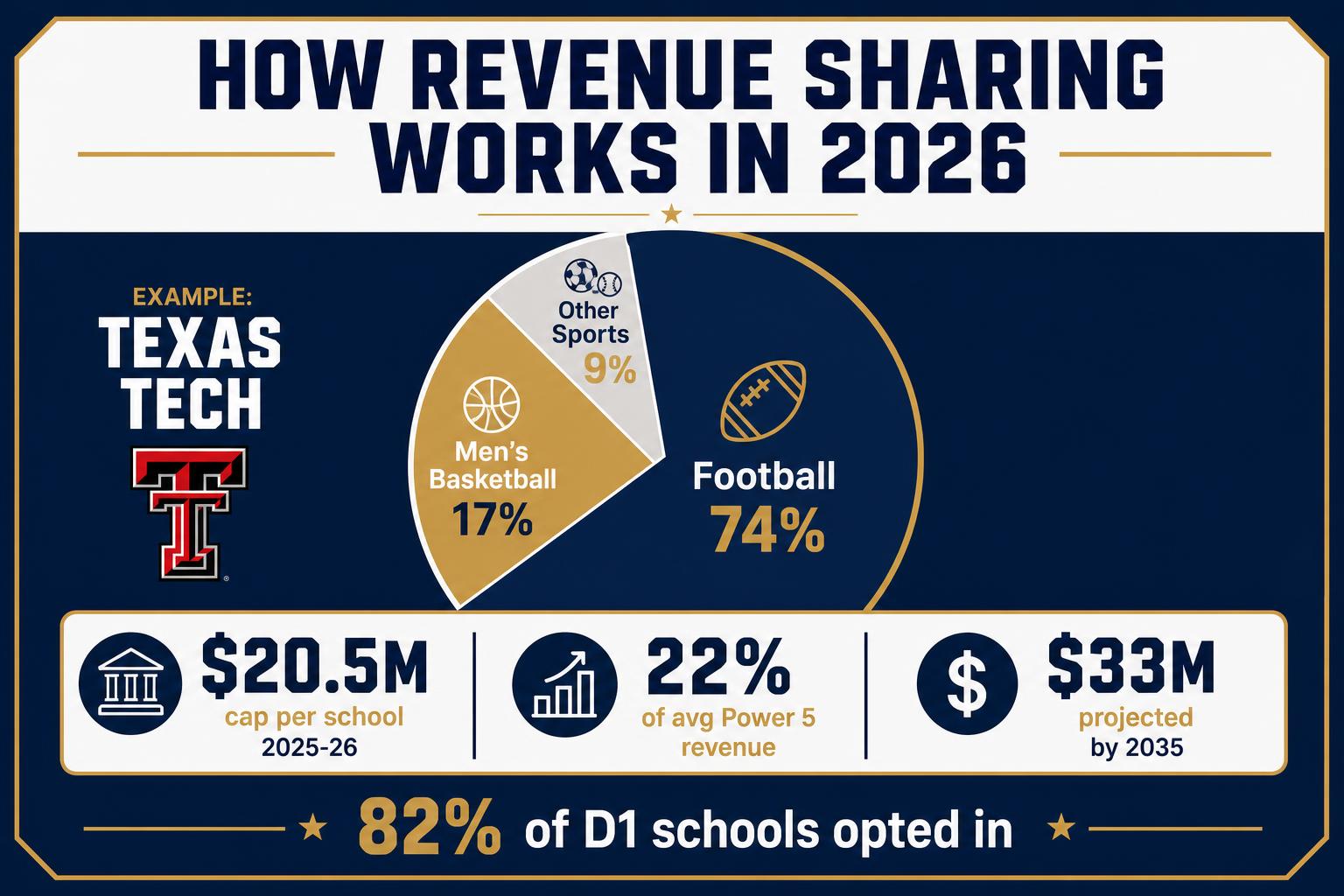
Each participating Division I institution may share up to 22% of the average revenue derived from media rights, ticket sales, and sponsorships across Power Five schools. For the 2025–2026 school year, that cap sits at approximately $20.5 million per school.
The cap grows each year. By 2035, it is projected to reach around $33 million per school.
A few things are worth knowing.
Opting in is not required. Schools choose whether to participate. Roughly 82% of Division I programs opted in by the July 1 deadline. Schools also decide how to divide the money among sports and athletes. Nothing in the settlement tells them how to split it.
Because football and men's basketball drive most athletic revenue, schools are directing the majority of their allocations to those programs. At Texas Tech, for example, 74% went to football and about 17–18% went to men's basketball. Other sports received a much smaller share.
To oversee the system, the Power Five conferences created the College Sports Commission (CSC), an independent body that handles enforcement and reviews compliance.
The cap grows each year. By 2035, it is projected to reach around $33 million per school.
A few things are worth knowing.
Opting in is not required. Schools choose whether to participate. Roughly 82% of Division I programs opted in by the July 1 deadline. Schools also decide how to divide the money among sports and athletes. Nothing in the settlement tells them how to split it.
Because football and men's basketball drive most athletic revenue, schools are directing the majority of their allocations to those programs. At Texas Tech, for example, 74% went to football and about 17–18% went to men's basketball. Other sports received a much smaller share.
To oversee the system, the Power Five conferences created the College Sports Commission (CSC), an independent body that handles enforcement and reviews compliance.
NIL vs. Revenue Sharing: What Is the Difference?
These two income streams are not competing with each other. They work alongside each other. Understanding the difference is important for planning your finances.
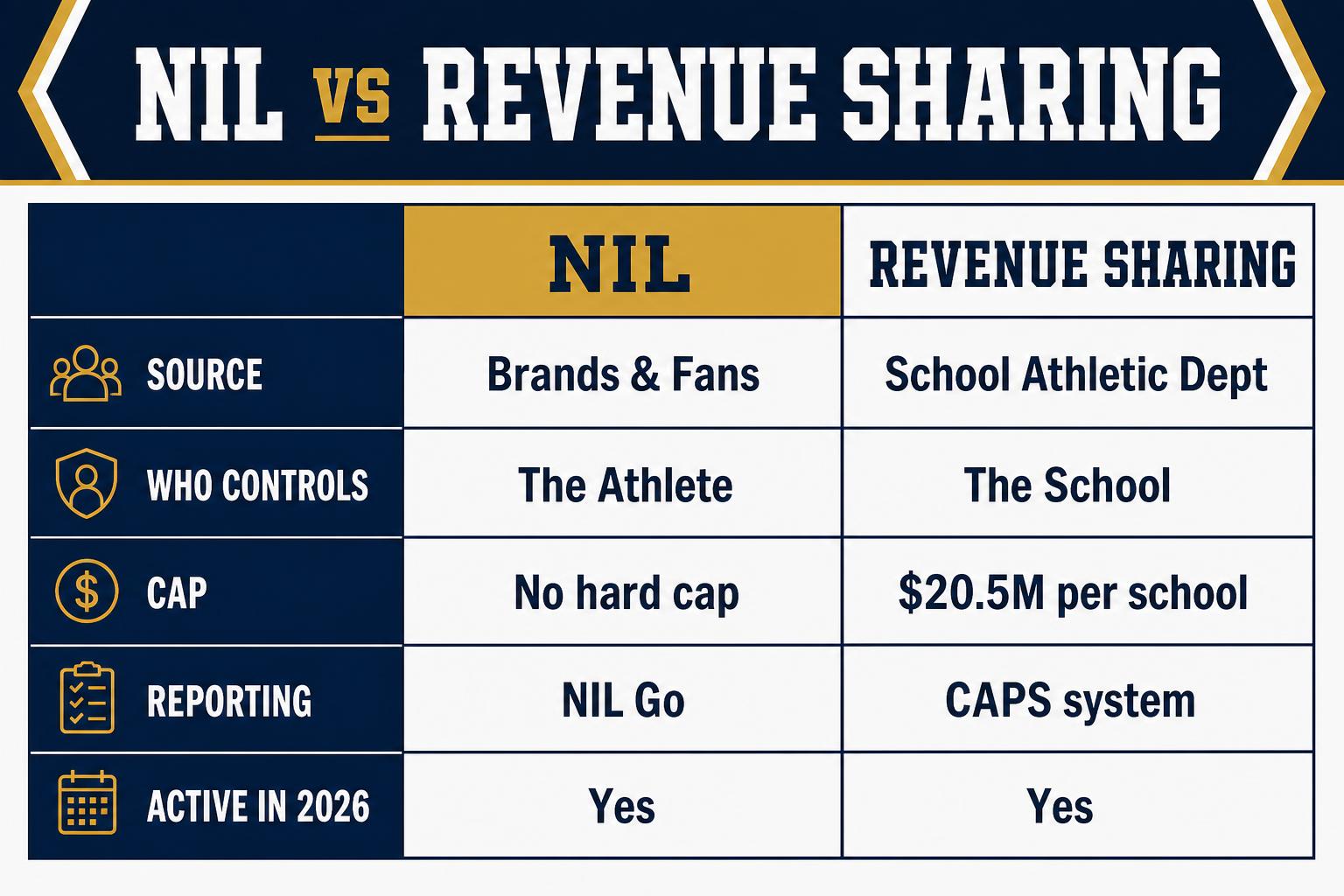
Revenue sharing comes from your school's athletic department. It is determined by your sport, your school, and how your athletics department chooses to allocate funds. You have little control over it.
NIL comes from outside the school. Brands, businesses, fans, and platforms pay athletes for use of their name, image, and likeness. You control how you pursue it and how much you build.
Here is a quick comparison:
Revenue sharing comes from your school's athletic department. It is determined by your sport, your school, and how your athletics department chooses to allocate funds. You have little control over it.
NIL comes from outside the school. Brands, businesses, fans, and platforms pay athletes for use of their name, image, and likeness. You control how you pursue it and how much you build.
Here is a quick comparison:
Does NIL Still Matter After the House Settlement?
Yes. Without question.
Some athletes assumed NIL would fade once direct school payments arrived. That has not happened. The College Sports Commission initially suggested that NIL collectives would not meet its valid business purpose standard. Within weeks, the commission reversed course. NIL continues to function alongside the new revenue-sharing system.
Third-party NIL deals are still very much active in 2026. The rules around them are more structured now, but the opportunity is real.
Division I athletes must report third-party deals of $600 or more through the NIL Go platform, typically within five business days. Deals are reviewed to confirm they reflect fair market value for actual services provided. Deals that look like disguised pay-to-play arrangements can be flagged and rejected.
The system rewards athletes who approach NIL seriously. Clear contracts, documented deliverables, and consistent reporting put athletes in a stronger position.
Some athletes assumed NIL would fade once direct school payments arrived. That has not happened. The College Sports Commission initially suggested that NIL collectives would not meet its valid business purpose standard. Within weeks, the commission reversed course. NIL continues to function alongside the new revenue-sharing system.
Third-party NIL deals are still very much active in 2026. The rules around them are more structured now, but the opportunity is real.
Division I athletes must report third-party deals of $600 or more through the NIL Go platform, typically within five business days. Deals are reviewed to confirm they reflect fair market value for actual services provided. Deals that look like disguised pay-to-play arrangements can be flagged and rejected.
The system rewards athletes who approach NIL seriously. Clear contracts, documented deliverables, and consistent reporting put athletes in a stronger position.
Who Actually Benefits From Revenue Sharing?
The honest answer is that it depends on your sport and your school.
Athletes in football and men's basketball at Power Four programs stand to benefit the most. High-profile players in these sports could receive hundreds of thousands or even millions of dollars in direct payments from their school.
For athletes in non-revenue sports, the picture looks different. Schools are not required to distribute revenue-sharing funds across all programs equally. Many allocate little or nothing to swimming, track, volleyball, wrestling, and other sports. Some athletes in these programs may receive only a few thousand dollars, or nothing at all.
Nothing in the House settlement controls how schools divide the $20.5 million pool. That decision belongs entirely to each athletic department.
This is one of the most important things athletes outside major revenue sports need to understand. Revenue sharing alone may not be a reliable income strategy. NIL remains your best direct opportunity to build meaningful earnings.
Athletes in football and men's basketball at Power Four programs stand to benefit the most. High-profile players in these sports could receive hundreds of thousands or even millions of dollars in direct payments from their school.
For athletes in non-revenue sports, the picture looks different. Schools are not required to distribute revenue-sharing funds across all programs equally. Many allocate little or nothing to swimming, track, volleyball, wrestling, and other sports. Some athletes in these programs may receive only a few thousand dollars, or nothing at all.
Nothing in the House settlement controls how schools divide the $20.5 million pool. That decision belongs entirely to each athletic department.
This is one of the most important things athletes outside major revenue sports need to understand. Revenue sharing alone may not be a reliable income strategy. NIL remains your best direct opportunity to build meaningful earnings.
New Rules Around NIL Deals in 2026
The compliance environment has tightened. Here is what changed.
NIL Go reporting applies to all Division I athletes. Any third-party deal over $600 must be reported within five business days. This creates a formal record and helps enforce fair market value standards across the board.
The College Sports Commission reviews NIL deals to determine whether they serve a legitimate commercial purpose. Deals that resemble pay-to-play arrangements, where the work required is minimal or the compensation is far above market rate, can be rejected.
Federal involvement has also increased. A new executive order signed in April 2026 seeks to impose national standards on NIL arrangements, targeting perceived abuses and limiting the influence of inconsistent state laws. Collectives and schools face increased regulatory scrutiny ahead of the August 1, 2026 effective date.
Taxes are a growing consideration as well. Student-athletes earning significant NIL or revenue-sharing income now face real state and federal tax obligations. Athletes who compete in multiple states may owe income tax in each one. Several states have proposed NIL tax exemptions, but most have not yet passed them into law.
The takeaway is straightforward. Treat every NIL deal like a real business agreement. Read it carefully, report it on time, and keep clear records. If you are not sure where to start, see our guide on how to get NIL sponsorship.
NIL Go reporting applies to all Division I athletes. Any third-party deal over $600 must be reported within five business days. This creates a formal record and helps enforce fair market value standards across the board.
The College Sports Commission reviews NIL deals to determine whether they serve a legitimate commercial purpose. Deals that resemble pay-to-play arrangements, where the work required is minimal or the compensation is far above market rate, can be rejected.
Federal involvement has also increased. A new executive order signed in April 2026 seeks to impose national standards on NIL arrangements, targeting perceived abuses and limiting the influence of inconsistent state laws. Collectives and schools face increased regulatory scrutiny ahead of the August 1, 2026 effective date.
Taxes are a growing consideration as well. Student-athletes earning significant NIL or revenue-sharing income now face real state and federal tax obligations. Athletes who compete in multiple states may owe income tax in each one. Several states have proposed NIL tax exemptions, but most have not yet passed them into law.
The takeaway is straightforward. Treat every NIL deal like a real business agreement. Read it carefully, report it on time, and keep clear records. If you are not sure where to start, see our guide on how to get NIL sponsorship.
How to Maximize Your Income Under Both Systems
Here is a practical approach to managing your earnings in 2026.
Know what revenue sharing will actually pay you. Talk to your athletic department early in the year. Find out how your program allocates funds and what you can realistically expect. If the number is small, that tells you how much work your NIL strategy needs to do.
Build your personal brand now. Revenue sharing is passive. NIL is active. Athletes who have invested time in their social media presence, fan relationships, and community connections attract more opportunities and better deals.
Document everything. Every deal, every payment, every deliverable. The new compliance environment rewards athletes who stay organized and penalizes those who miss reporting windows or cannot verify a deal's legitimacy.
Do not rely on a single income stream. Revenue sharing is controlled by your school. Traditional NIL deals depend on outside partners. Fan-supported platforms are athlete-controlled. A strong income strategy uses all three layers.
Understand your tax situation. Talk to a tax professional who works with athletes. NIL income and revenue-sharing payments are both taxable, and the rules vary by state.
Know what revenue sharing will actually pay you. Talk to your athletic department early in the year. Find out how your program allocates funds and what you can realistically expect. If the number is small, that tells you how much work your NIL strategy needs to do.
Build your personal brand now. Revenue sharing is passive. NIL is active. Athletes who have invested time in their social media presence, fan relationships, and community connections attract more opportunities and better deals.
Document everything. Every deal, every payment, every deliverable. The new compliance environment rewards athletes who stay organized and penalizes those who miss reporting windows or cannot verify a deal's legitimacy.
Do not rely on a single income stream. Revenue sharing is controlled by your school. Traditional NIL deals depend on outside partners. Fan-supported platforms are athlete-controlled. A strong income strategy uses all three layers.
Understand your tax situation. Talk to a tax professional who works with athletes. NIL income and revenue-sharing payments are both taxable, and the rules vary by state.
Where NIL Club Fits Into This New Model
Revenue sharing and traditional NIL deals are both valuable. But neither one puts athletes fully in control.
Revenue sharing is decided by your school. A brand deal depends on a company choosing to work with you. Both require outside parties to determine what your time and name are worth.
NIL Club works differently. It is a fan-supported, athlete-run platform where supporters subscribe monthly to access exclusive content directly from the athletes they follow. Every athlete on the team earns an equal share of the revenue. There are no donors, no approval processes, and no gatekeepers.
For athletes in non-revenue sports, NIL Club fills a real gap. Revenue sharing often leaves these athletes behind, but a strong fan community does not care about your sport's budget line. For athletes in football or basketball, it is an additional income stream that runs independently from the revenue-sharing cap and requires no third-party approval.
Learn more about how NIL Club helps student-athletes balance sports, school, and earning.
Revenue sharing is decided by your school. A brand deal depends on a company choosing to work with you. Both require outside parties to determine what your time and name are worth.
NIL Club works differently. It is a fan-supported, athlete-run platform where supporters subscribe monthly to access exclusive content directly from the athletes they follow. Every athlete on the team earns an equal share of the revenue. There are no donors, no approval processes, and no gatekeepers.
For athletes in non-revenue sports, NIL Club fills a real gap. Revenue sharing often leaves these athletes behind, but a strong fan community does not care about your sport's budget line. For athletes in football or basketball, it is an additional income stream that runs independently from the revenue-sharing cap and requires no third-party approval.
Learn more about how NIL Club helps student-athletes balance sports, school, and earning.
A Realistic Picture of Athlete Pay in 2026
The headlines focus on million-dollar deals. Most athletes are not in that conversation, and pretending otherwise does not help anyone.
A more realistic income picture for many Division I athletes includes three layers. Revenue sharing provides a base that ranges from a few thousand dollars to significant sums, depending entirely on your sport and school. Traditional NIL deals vary widely based on your brand, your market, and the deals you pursue. Fan-supported platforms offer steady, predictable income based on the community you build over time.
None of these replaces the others. The athletes building real financial stability in 2026 treat all three as part of a coordinated plan.
A more realistic income picture for many Division I athletes includes three layers. Revenue sharing provides a base that ranges from a few thousand dollars to significant sums, depending entirely on your sport and school. Traditional NIL deals vary widely based on your brand, your market, and the deals you pursue. Fan-supported platforms offer steady, predictable income based on the community you build over time.
None of these replaces the others. The athletes building real financial stability in 2026 treat all three as part of a coordinated plan.
What to Watch in the Months Ahead
The system is still evolving. A few developments to follow.
Federal NIL legislation is still unresolved. Congress has debated national NIL rules since 2025, but no bill has passed. Any federal law could change the landscape quickly.
Title IX challenges are ongoing. Female athletes have challenged aspects of the settlement related to how revenue-sharing funds are distributed across sports. A federal appeals court has not yet ruled.
Revenue-sharing caps increase 4% per year. The pool continues to grow, which is good news for athletes across all sports over the long term.
Staying informed matters. The rules that apply today may look different by the time next season starts.
Federal NIL legislation is still unresolved. Congress has debated national NIL rules since 2025, but no bill has passed. Any federal law could change the landscape quickly.
Title IX challenges are ongoing. Female athletes have challenged aspects of the settlement related to how revenue-sharing funds are distributed across sports. A federal appeals court has not yet ruled.
Revenue-sharing caps increase 4% per year. The pool continues to grow, which is good news for athletes across all sports over the long term.
Staying informed matters. The rules that apply today may look different by the time next season starts.
What Athletes and Families Should Keep in Mind
The new model gives athletes more earning potential than ever before. It also comes with more responsibility.
Revenue sharing is real, but it is not evenly distributed. Know your sport's share before you count on it. NIL is still active and still valuable, but the compliance requirements are stricter now. Every deal needs documentation. Every payment above $600 needs reporting.
The athletes who thrive in this environment are the ones who treat their NIL like a business from day one. That means reading contracts, filing on time, building genuine relationships with fans and brands, and planning for taxes.
Parents and coaches play a role too. Helping athletes understand these systems early gives them a real advantage, both financially and professionally.
Revenue sharing is real, but it is not evenly distributed. Know your sport's share before you count on it. NIL is still active and still valuable, but the compliance requirements are stricter now. Every deal needs documentation. Every payment above $600 needs reporting.
The athletes who thrive in this environment are the ones who treat their NIL like a business from day one. That means reading contracts, filing on time, building genuine relationships with fans and brands, and planning for taxes.
Parents and coaches play a role too. Helping athletes understand these systems early gives them a real advantage, both financially and professionally.
The Bottom Line
Revenue sharing changed college sports for good. But it did not replace NIL. It added to it.
In 2026, the smartest athletes are the ones who understand both systems, build their brand alongside their sport, and find income sources they actually control.
NIL Club is built for that. It gives athletes a direct line to their fans, equal revenue sharing within their team, and a platform that does not depend on boosters, brands, or school budget decisions.
To explore athlete-run communities or start supporting your favorite team, download the NIL Club app today.
In 2026, the smartest athletes are the ones who understand both systems, build their brand alongside their sport, and find income sources they actually control.
NIL Club is built for that. It gives athletes a direct line to their fans, equal revenue sharing within their team, and a platform that does not depend on boosters, brands, or school budget decisions.
To explore athlete-run communities or start supporting your favorite team, download the NIL Club app today.