

What This Subway Brand Deal Taught Us About Creating Posts That Truly Work
7 min read
Most social media posts disappear within minutes. A few travel further than expected. And once in a while, a campaign reveals why certain content works while most doesn't. Most brand deals perform right where we expect them to. Some do a little better. And every once in a while, a campaign gives us clear lessons that are worth sharing with the entire community.
The recent Subway brand deal was one of those campaigns.
This wasn't designed to chase viral moments or lean on a single standout athlete. The goal was simple and practical. We wanted to bring together a large group of student-athletes, give them the freedom to create content that felt real and see how it performed when it was allowed to live naturally on platforms like TikTok and Instagram.
We learned a lot about what works, why it does, and how authenticity benefits both athletes and brands.
The recent Subway brand deal was one of those campaigns.
This wasn't designed to chase viral moments or lean on a single standout athlete. The goal was simple and practical. We wanted to bring together a large group of student-athletes, give them the freedom to create content that felt real and see how it performed when it was allowed to live naturally on platforms like TikTok and Instagram.
We learned a lot about what works, why it does, and how authenticity benefits both athletes and brands.
A Simple Look at the Results
To provide a clear background, before we dive into the content, let's review the campaign's results.
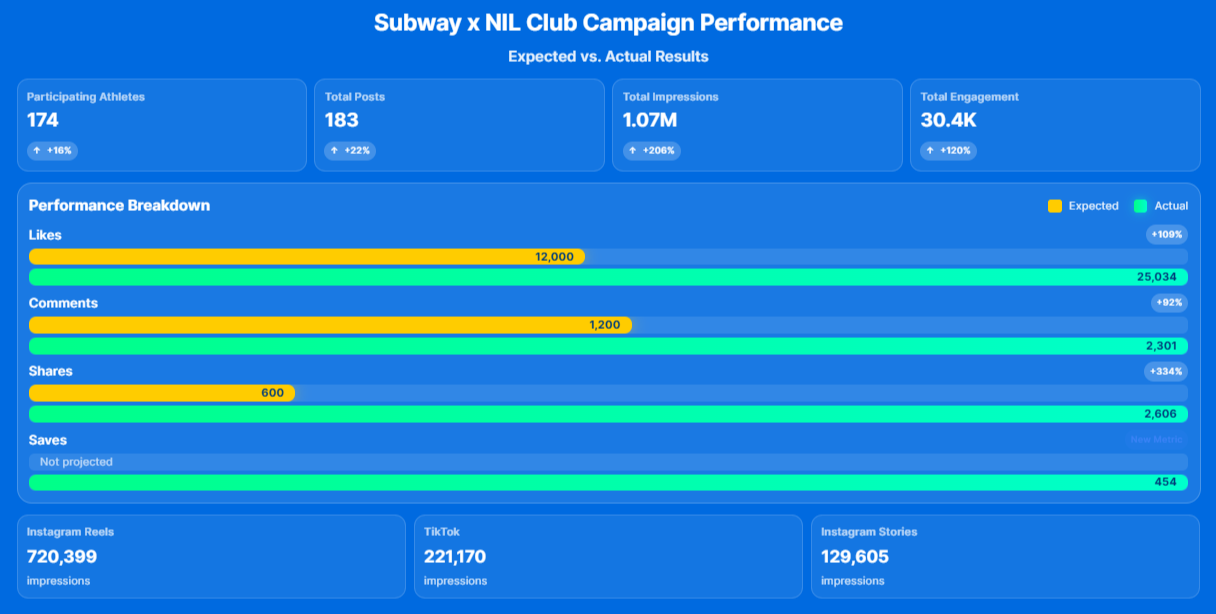
As mentioned earlier, we had planned to activate approximately 150 student-athletes and expected the campaign to deliver about 350,000 impressions. That would have been a very positive result, no matter the criteria used to measure the campaign's success.
However, the campaign exceeded our expectations in terms of reach. In the end, 174 student-athletes created 183 posts across TikTok, Instagram Reels, and Stories. Those posts delivered 1,071,174 impressions, more than 3 times the number we projected. The number of likes and comments also greatly exceeded our projections, and the number of shares we received was more than 4 times what we anticipated. Even though we did not anticipate receiving many saves, we received a significant number.
The campaign's most notable aspect was not the number of impressions but how many people engaged with and shared the content.
As mentioned earlier, we had planned to activate approximately 150 student-athletes and expected the campaign to deliver about 350,000 impressions. That would have been a very positive result, no matter the criteria used to measure the campaign's success.
However, the campaign exceeded our expectations in terms of reach. In the end, 174 student-athletes created 183 posts across TikTok, Instagram Reels, and Stories. Those posts delivered 1,071,174 impressions, more than 3 times the number we projected. The number of likes and comments also greatly exceeded our projections, and the number of shares we received was more than 4 times what we anticipated. Even though we did not anticipate receiving many saves, we received a significant number.
The campaign's most notable aspect was not the number of impressions but how many people engaged with and shared the content.
Where the Reach Really Came From
The reach was driven by a steady build-up of short-form video content across multiple platforms (Instagram Reels, TikTok, and Instagram Stories) rather than by a single viral clip or a single athlete driving the campaign.
Content was posted across dozens of athlete accounts, campuses, and communities, and therefore, the reach grew naturally over time.
This is how Gen Z views and consumes content. People generally view content from people they know, content that fits natively within their feed, and moments that resemble their daily lives rather than ads.
Content was posted across dozens of athlete accounts, campuses, and communities, and therefore, the reach grew naturally over time.
This is how Gen Z views and consumes content. People generally view content from people they know, content that fits natively within their feed, and moments that resemble their daily lives rather than ads.
What Made These Posts Successful
When we reviewed the highest-performing posts from the campaign, some clear patterns emerged. The content didn't succeed because of fancy editing or polished production. It worked because of how the stories were told.
The most viewed TikTok came from Natalie Wagner, who centered her video on something nearly every college athlete recognizes: the afternoon energy dip that hits around 3 p.m. Her post showed an early lift, a paper deadline approaching, and a quick break in between. Subway wasn't presented as something being promoted. It simply showed up as part of her routine.
On Instagram, one of the top-performing Reels came from Valerie Michelle Van Dijk (@ihoop.valerie), who has 179,000 followers. Her video focused on how busy student-athletes really are, moving from classes to practice with limited time in between. She framed food as fuel that helps her stay consistent and active throughout long days.
What connected the two posts was their specificity. Each one focused on a single, relatable moment rather than trying to cover everything at once. The content felt familiar, which made it easy for viewers to see themselves in it.
The most viewed TikTok came from Natalie Wagner, who centered her video on something nearly every college athlete recognizes: the afternoon energy dip that hits around 3 p.m. Her post showed an early lift, a paper deadline approaching, and a quick break in between. Subway wasn't presented as something being promoted. It simply showed up as part of her routine.
On Instagram, one of the top-performing Reels came from Valerie Michelle Van Dijk (@ihoop.valerie), who has 179,000 followers. Her video focused on how busy student-athletes really are, moving from classes to practice with limited time in between. She framed food as fuel that helps her stay consistent and active throughout long days.
What connected the two posts was their specificity. Each one focused on a single, relatable moment rather than trying to cover everything at once. The content felt familiar, which made it easy for viewers to see themselves in it.
What This Campaign Means for Student-Athletes
If you are a student-athlete creating content on NIL Club, one of the biggest lessons from this campaign is that you don't need to overthink it.
The athletes whose posts performed best weren't trying to impress anyone. They weren't explaining their partnership or walking viewers through a script. They simply showed a real part of their day that others could relate to.
That approach works because it feels honest. It allows viewers to connect without feeling sold to. Any athlete can do this, regardless of sport, school, or follower count.
The athletes whose posts performed best weren't trying to impress anyone. They weren't explaining their partnership or walking viewers through a script. They simply showed a real part of their day that others could relate to.
That approach works because it feels honest. It allows viewers to connect without feeling sold to. Any athlete can do this, regardless of sport, school, or follower count.
What This Means for Brands
For brands, the takeaway is just as important.
Working with college athletes isn't only about finding one big name. The real value comes from connecting with many athletes who speak naturally to their communities. When brands give athletes room to create in their voice, the content feels more human and tends to perform better.
Through the Brand Deals tab on NIL Club, brands can connect with hundreds or even thousands of athletes at once while still making each post feel personal. So far, more than 50,000 student-athletes have completed brand deals, and campaigns across the platform have driven over 3 million verified conversions. That combination of scale and authenticity is difficult to achieve anywhere else.
Working with college athletes isn't only about finding one big name. The real value comes from connecting with many athletes who speak naturally to their communities. When brands give athletes room to create in their voice, the content feels more human and tends to perform better.
Through the Brand Deals tab on NIL Club, brands can connect with hundreds or even thousands of athletes at once while still making each post feel personal. So far, more than 50,000 student-athletes have completed brand deals, and campaigns across the platform have driven over 3 million verified conversions. That combination of scale and authenticity is difficult to achieve anywhere else.
The Bigger Lesson
The Subway campaign didn't work because it was flashy or heavily produced. It worked because it reflected real life.
For athletes, success came from sharing honest moments that felt familiar. For brands, success came from trusting athletes to tell those stories in their own way.
When those two things come together, content travels further, engagement feels natural, and everyone involved benefits.
That is what NIL Club is built to support, and it's what we're excited to keep building alongside our athletes and brand partners.
For athletes, success came from sharing honest moments that felt familiar. For brands, success came from trusting athletes to tell those stories in their own way.
When those two things come together, content travels further, engagement feels natural, and everyone involved benefits.
That is what NIL Club is built to support, and it's what we're excited to keep building alongside our athletes and brand partners.